


Division of Cellular and Molecular Toxicology
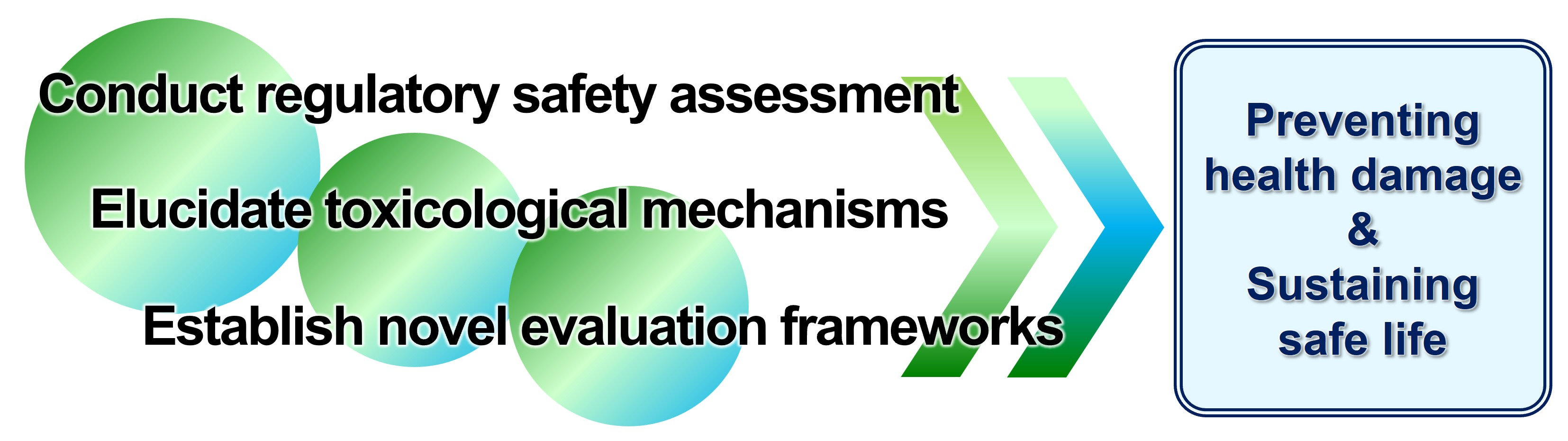
To ensure the safety of chemicals, foods and medicines, our division is conducting regulatory safety assessments by examining toxicity test data, and research to elucidate toxicological mechanism of action and to establish novel evaluation methods.
We have been also engaged in visionary investigation and research on toxicological issues, such as endocrine disruptors, nanomaterials, PFAS (organic fluorine compounds) which are difficult to evaluate within existing frameworks.
By integrating traditional methods and cutting-edge technologies, we will develop refined toxicity assessment systems. Through implementation of those systems into regulatory frameworks, we will prevent adverse effects on human health and contribute to sustaining safe and healthy life of public.
Past, Present, and Future of the Division of Cellular and Molecular Toxicology
— Shifting from Building up Trust to Establishing Next-Generation Assessment Framework: Our Journey and Vision to Lead the Regulatory Implementation of Toxicology —
Toxicology is a scientific discipline aimed at protecting human health from adverse effects. It achieves this by identifying undesirable responses (toxicity) caused by pharmaceuticals and chemical substances, and by elucidating their underlying mechanisms of action. Our division, based on this foundation of toxicology, has provided scientific support to the safety assessment of a diverse range of substances in our country since its establishment in 1964.
Our division’s history began, following the thalidomide tragedy, in response to a strong societal demand to protect the safety of pharmaceuticals through scientific means. Since then, we have identified adverse effects, through over 300 extensive toxicity tests concerning various safety issues, related to methylmercury, AF-2 (furylfuramide), genetically modified foods, and dietary supplements, providing reliable scientific evidence to support regulatory decisions. This accumulation of data and expertise over decades forms the basis of public trust in our division.
With rapid advances in life sciences, toxicology is also undergoing a paradigm shift from qualitative to quantitative assessment, and from correlation to causation. This shift necessitates a review of conventional safety assessment methodologies. Consequently, there is growing momentum worldwide for the development of novel approaches alternative to traditional animal testing, such as New Approach Methodologies (NAMs). Our division was among the earliest to adopt toxicogenomics and systems toxicology to comprehensively and quantitatively analyze biological phenomena at the molecular level. Furthermore, we are actively pursuing the development of minimally invasive biomarkers through exosome analysis and the construction of non-invasive, longitudinal evaluation methods using wearable devices or magnetic resonance imaging (MRI). These efforts represent the true embodiment of regulatory science—translating cutting-edge science into practical applications that serve human health and society. Simultaneously, through fusion of traditional expertise with advanced technologies, we are also promoting research to overcome complex, hard-to-evaluate challenges, including the biological impacts of endocrine disruptors or nanomaterials, as well as the effects of chemical substances on emotional, cognitive, and behavioral functions.
Going forward, it is crucial to develop next-generation safety assessment methods/framework through expanding the vast accumulated knowledge of toxicology. To achieve this, we steadily commit to safety assessments using traditional methods necessary for current regulatory decisions, Concurrently, we will lead the way in establishing the scientific standards necessary for the regulatory and societal implementation of emerging technologies like NAMs, ensuring they are utilized in a scientifically robust manner. Our enduring mission is to protect public health and sustain safe living environments. Our division will keep striving together to achieve this goal.